Blog

  • Lipia Pole Pole

    Lipia Pole Pole


    Lipia Pole Pole — Early‑Stage Credit Management Platform Case Study

    Product Type: Credit management & invoicing system
    Stage: Early launch / first users

    Project URL:
    https://lipiapolepole.com/


    The Problem

    For many Kenyan businesses, credit management is a tangled mess of spreadsheets, WhatsApp messages, and memory. The typical pain points include:

    • No centralized client ledger — Balances and payment history live in scattered notes.
    • Invoice confusion — Creating, tracking, and reconciling invoices often creates more work than the sale itself.
    • Unreliable payment visibility — Businesses struggle to know who paid what and when.

    These inefficiencies cost time, burn valuable cash flow, and increase the risk of losses — especially for small service providers and MSMEs.


    The Insight

    Businesses don’t fail because they’re bad at credit — they fail because their systems are poorly suited to real workflows.

    From observing how local businesses handle credit and invoicing, a few truths emerged:

    • Owners want clarity, not complexity
    • Small teams don’t need enterprise ERP
    • They need real‑time, trustworthy data
    • They need something that just works

    Instead of adding yet another accounting layer, Lipia Pole Pole asks:

    What if you could manage credit with a system that feels familiar, not foreign?


    The Solution

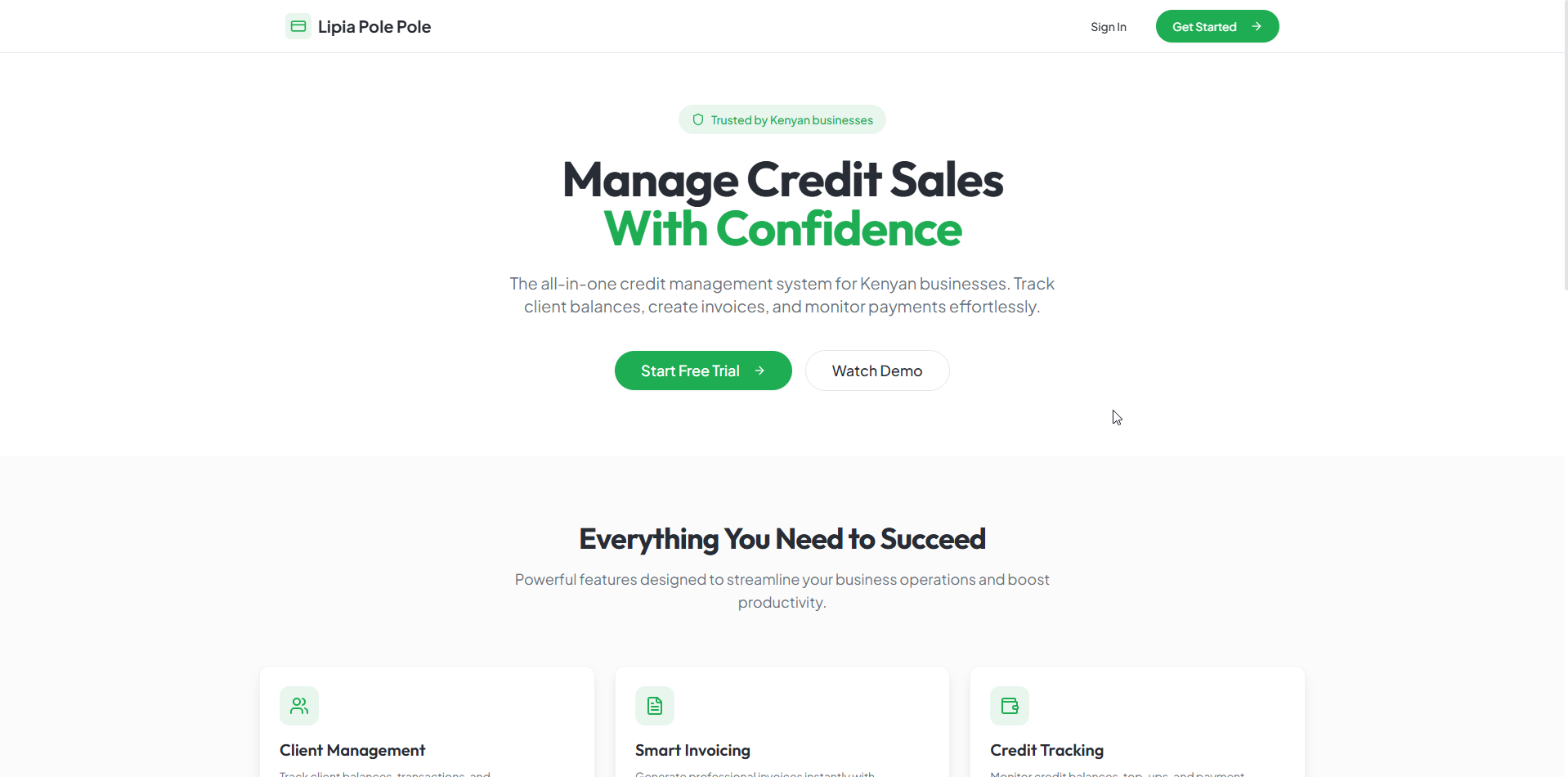
    Lipia Pole Pole was created to give Kenyan businesses a simple, secure, and centralized way to manage credit, clients, and invoices — without the chaos.

    Client Management

    • Track every customer’s balance in one place
    • View payment history at a glance
    • Reduce disputes with clear records

    Invoice Tracking

    • Create and issue invoices instantly
    • Monitor statuses automatically — paid, pending, overdue
    • Eliminate manual follow‑ups and lost documents

    Secure & Reliable

    • Enterprise‑grade security for sensitive financial data
    • Encryption and access controls
    • Peace of mind for business owners and their clients

    All features are designed with Kenyan business realities in mind — low overhead, minimal setup, and immediate value.


    Early Signals & Validation

    Lipia Pole Pole, while early, already shows meaningful signals:

    • Users log clients and invoice data faster than in spreadsheets
    • Small businesses report fewer reconciliation headaches
    • Early users praise the visibility of payment history
    • Business owners feel more confident talking about cash-flow status to partners and lenders

    These are not vanity metrics — they’re early behavioral signals that the core problem is being solved.


    Why This Matters

    Lipia Pole Pole proves a simple but foundational product principle:

    Clarity drives confidence.

    When business owners know exactly who owes what, and when payments are due, they:

    • Plan smarter
    • Collect faster
    • Grow with assurance

    Most credit systems either bury data in complexity or leave gaps that create even more work. Lipia Pole Pole flips that:

    • Real‑time tracking beats post‑hoc reconciliation
    • Centralized client info beats scattered notes
    • Automated invoice statuses beat guesswork

    This makes it especially useful for:

    • MSMEs and freelancers
    • Small service providers
    • Shop owners and credit‑based businesses
    • Teams that prefer accuracy over chaos

    What’s Next

    As the product evolves, future enhancements include:

    • Reminders and automated payment nudges
    • Exportable financial reports
    • Integration with M‑Pesa and mobile money payouts
    • Multi‑user access and role permissions

    The core mission remains: Make credit simple and trustworthy so businesses can focus on growth, not spreadsheets.

  • ConstructLedger

    ConstructLedger


    ConstructLedger — Early‑Stage Product Case Study

    Product Type: Tactical profit tracking & project finance engine
    Stage: Early launch / first users

    Project URL:
    https://constructledger.bunisystems.com/


    The Problem

    Construction companies deserve to know exactly how profitable each project is — but real life rarely works that way.

    Common pain points include:

    • Unclear project profitability — Costs and revenues are scattered across spreadsheets, inboxes, and tribal knowledge
    • Delayed financial insight — Profit reporting often only happens after a job is done, too late for corrections
    • Data chaos — Materials, labor, equipment, subcontractor costs, and income are logged in disconnected systems

    The result? Decisions are based on gut instinct, not timely financial truth.


    The Insight

    The core business reality for construction is:

    Profit isn’t a high‑level summary — it’s a project‑by‑project story.

    Meaningful financial control doesn’t come from broad balance sheets — it comes from:

    • Knowing per job profit
    • Seeing costs as they happen
    • Tying expenses directly to deliverables

    Existing tools either over‑generalize (accounting suites) or require endless configuration (enterprise ERP), leaving small and mid‑size contractors in the lurch.

    But here’s the critical insight:

    Most construction teams don’t need complexity — they need clarity.


    The Solution

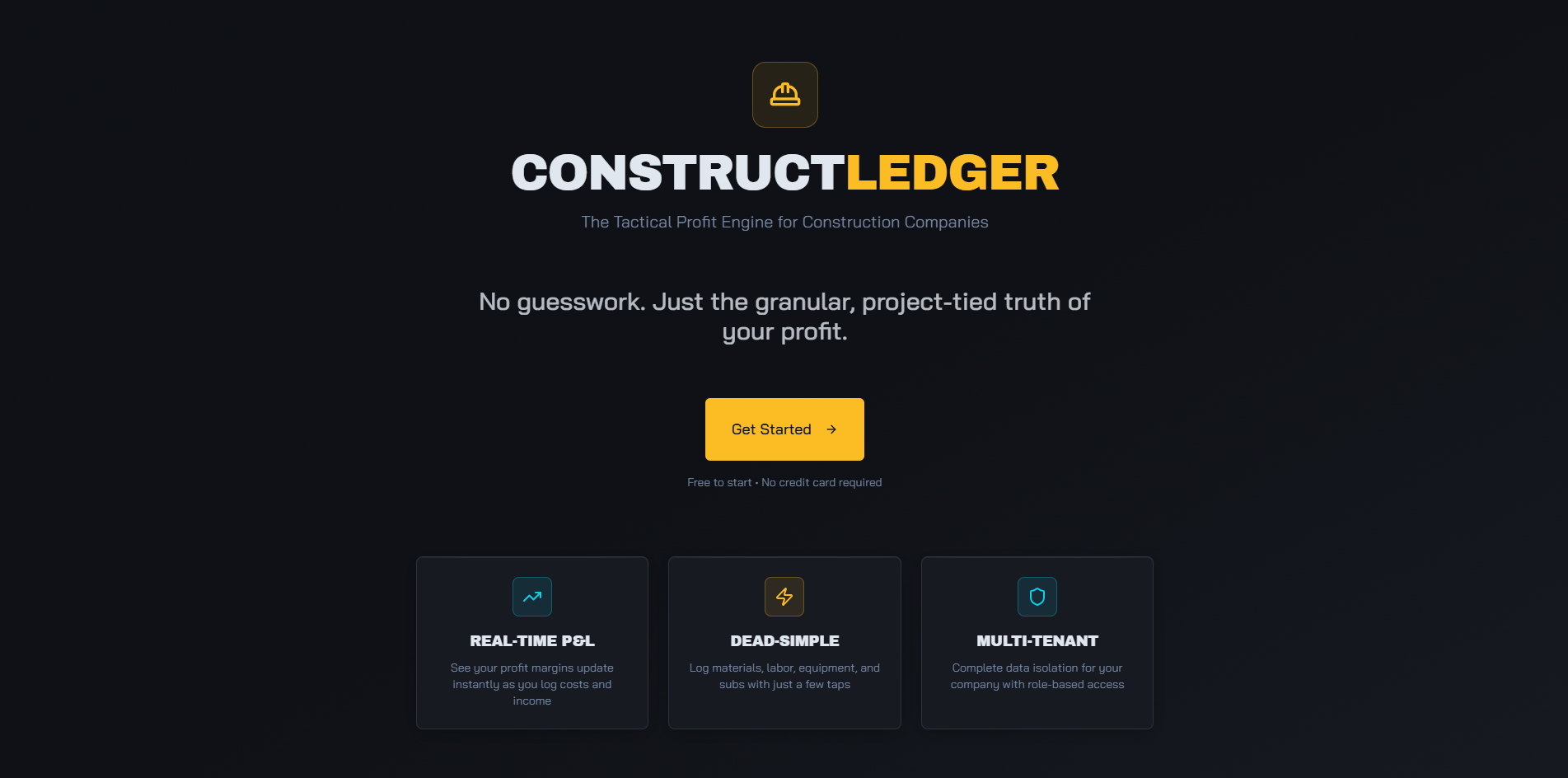
    ConstructLedger was designed to be simple, real‑time, and project‑centric, focusing on what matters most for construction profitability.

    Real‑Time P&L (Profit & Loss)

    See profit margins instantly as you log costs and income — no waiting for month‑end reports.

    Easy Cost Logging

    Log all major cost types with minimal friction:

    • Materials
    • Labor
    • Equipment
    • Subcontractors (subs)

    Just a few taps, no spreadsheet gymnastics.

    Multi‑Tenant with Role Access

    • Each company’s data is isolated
    • Role‑based permissions ensure the right team members see the right data
    • Scales from small teams to larger orgs

    Built for Construction Workflows

    Forget financial jargon and complex menus — ConstructLedger speaks project language:

    • Job by job reporting
    • Line‑item cost inputs
    • Profit visibility per task

    Early Signals & Validation

    ConstructLedger is early, but the initial traction is promising:

    • Users report faster visibility into profitability than traditional methods
    • Project managers appreciate real‑time updates vs. monthly reconciliations
    • Small construction teams use it as both an operational and financial tool
    • Early adopters describe it as “the profit clarity we always wished for

    No inflated vanity numbers — just honest, consistent signals that the tool is actually solving pain.


    Why This Matters

    ConstructLedger embodies a critical product principle:

    Profit clarity beats complexity every time.

    Traditional accounting systems are great for compliance — not for day‑to‑day project decision making in construction.

    By focusing on:

    • Real‑time P&L
    • Minimal logging friction
    • Project‑centered workflows

    ConstructLedger enables teams to feel the financial truth while the job is still live, not after the fact.

    This makes it especially powerful for:

    • Small & mid‑size contractors
    • Project managers responsible for margins
    • Teams that prefer answers over guesswork

    What’s Next

    As ConstructLedger matures, the roadmap prioritizes:

    • Invoicing and payment reconciliation
    • Cost forecasting & variance analysis
    • Mobile‑optimized data capture
    • Reporting exports & integrations with existing finance tools

    The mission remains the same: make profit visible, actionable, and immediate.


  • Syndra M-Pesa Wrapper

    Syndra M-Pesa Wrapper

    M-Pesa Wrapper — Early-Stage Developer Payments Platform Case Study

    Product Type: Developer-focused M-Pesa API wrapper
    Stage: Early launch / first users

    Project URL:
    https://syndra.bunisystems.com/


    The Problem

    Integrating M-Pesa payments into apps is notoriously painful.

    • Confusing documentation — Safaricom’s API docs are dense and hard to follow.
    • Callback headaches — Developers waste hours troubleshooting STK Push, C2B, and B2C responses.
    • Security and multi-tenancy gaps — Scaling across multiple users or clients is complex and error-prone.

    The result? Developers spend more time wrestling with payments than building actual features.


    The Insight

    Developers don’t need another payment service—they need clarity, reliability, and control.

    From observing fintech developers and early adopters:

    • Debugging M-Pesa integrations is a recurring frustration
    • Developers abandon integrations if callbacks fail or security is brittle
    • Simplified tooling dramatically reduces time-to-production

    Key insight:

    Make payments “just work” without compromising flexibility, multi-tenancy, or security — and developers will actually use it.


    The Solution

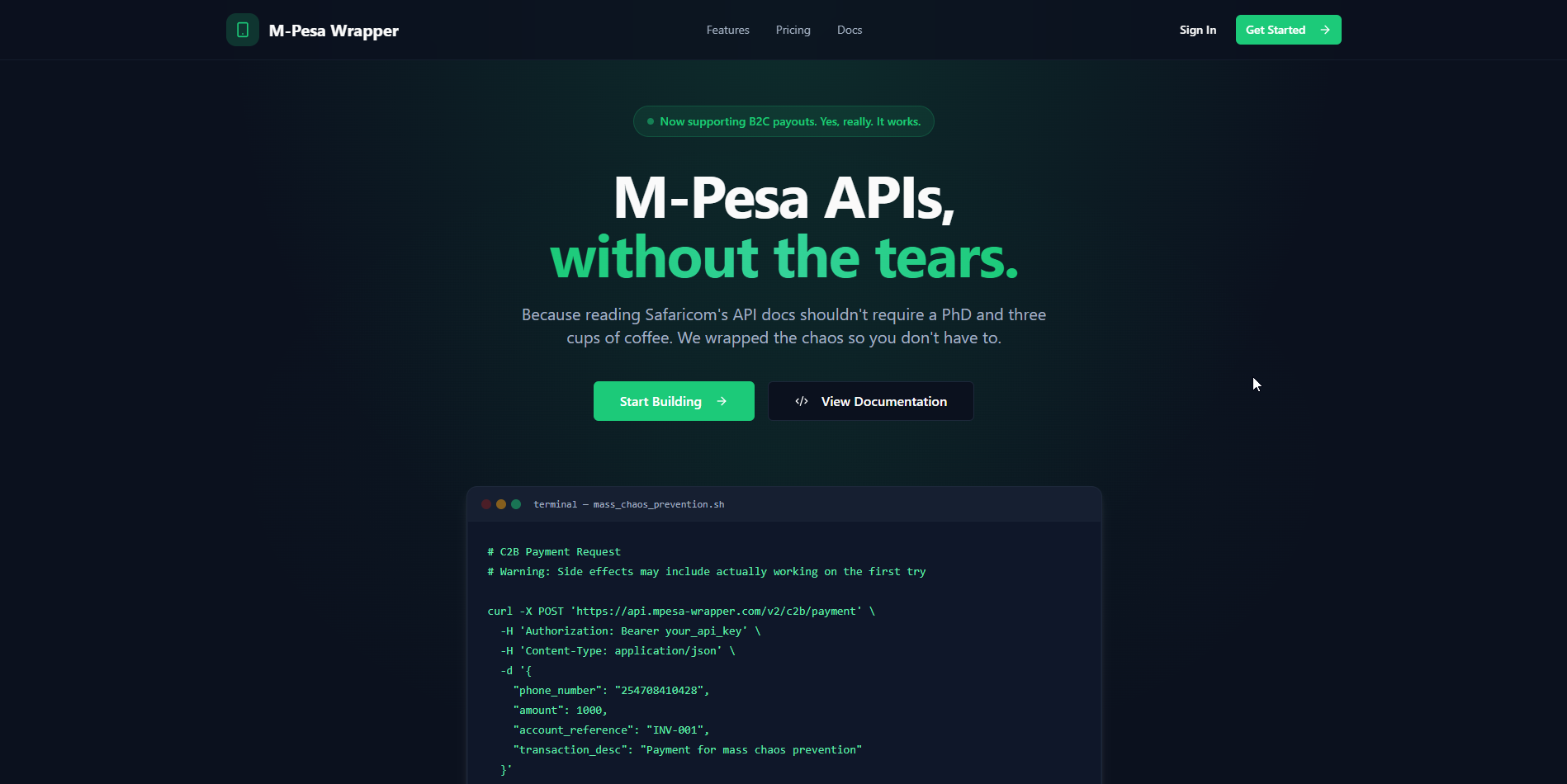
    M-Pesa Wrapper was designed developer-first to remove pain points and make payment integration predictable and fast.

    Developer-Focused API

    • Clean REST APIs with proper documentation
    • Ready-to-use examples and STK Push / C2B / B2C endpoints
    • Callback handling is automatic — developers never chase missing responses

    Multi-Tenant Architecture

    • Isolates customers in dedicated tenants
    • Enables scalable, secure deployments for multiple clients

    Scoped API Keys & Enterprise Security

    • Generate keys with granular permissions
    • JWT auth, role-based access control, encryption everywhere

    Real-Time Payments & Analytics

    • Instant STK Push, B2C, C2B
    • Built-in dashboards visualize transactions
    • Early users can track and prove ROI quickly

    Developer-Friendly Experience

    • Free tier for testing & hobbyists
    • Paid tiers scale gracefully for small businesses, serious builders, and enterprise
    • Humorous, humanized tone reduces friction and builds trust

    Early Signals & Validation

    Initial adoption signals confirm the assumptions:

    • Developers integrate in minutes rather than hours
    • Test transactions and callbacks succeed consistently on first try
    • Users report reduced support tickets and faster go-to-market cycles
    • Analytics dashboards improve transparency and stakeholder confidence

    Even at early stage, M-Pesa Wrapper validates: simpler, reliable developer tooling accelerates fintech product launches.


    Why This Matters

    M-Pesa Wrapper proves a principle for fintech and developer platforms:

    Eliminate integration pain first; users will adopt before features matter.

    Key differentiators:

    • Reliability over complexity
    • Developer-first thinking, not enterprise-first documentation
    • Humor and clarity build trust in a painful ecosystem

    Ideal for:

    • Early-stage fintech startups
    • Independent developers building payment-enabled apps
    • Companies scaling multiple client integrations

    What’s Next

    Future priorities:

    • Expand multi-tenancy and enterprise features
    • Introduce more API endpoints and webhook support
    • Enhance analytics and real-time dashboards
    • Maintain frictionless onboarding while growing the user base

    The focus remains: developers spend time building features, not debugging payments.


  • 📘 Google Search Essentials & Spam Policies: Part 4

    🔍 Introduction to SEO

    Search Engine Optimization (SEO) is the practice of improving a website so it appears more visibly in search engine results, helping attract relevant traffic.

    SEO can refer to:

    • The process of optimizing a website
    • A job role (an SEO specialist)

    Even basic SEO knowledge is valuable, especially if:

    • You use platforms like Blogger, Wix, or Squarespace
    • You run a small business
    • You have limited time for website management

    A small effort can significantly improve discoverability 🚀


    🧱 Google Search Essentials

    Google Search Essentials define what makes content eligible to appear and perform well in Google Search.

    They apply to:

    • Web pages
    • Images
    • Videos
    • Publicly available online content

    Core Components

    ⚙️ Technical Requirements

    Minimum technical conditions a page must meet to be eligible for Google Search.
    Most sites already meet these unintentionally.

    🚫 Spam Policies

    Rules defining behaviors that can:

    • Lower rankings
    • Remove pages or entire sites from search results

    ✅ Key Best Practices

    High-impact actions that improve ranking and appearance in Search results.

    💡 Meeting these requirements does not guarantee crawling, indexing, or ranking.


    ⚙️ Technical Requirements (Eligibility Basics)

    To be eligible for indexing, a page must:

    1. 🤖 Not block Googlebot
    2. Return HTTP 200 (Success)
    3. 📄 Contain indexable content

    Indexing is not guaranteed, even if all requirements are met.


    🤖 Googlebot Accessibility

    Google only indexes pages that:

    • Are publicly accessible
    • Do not block Googlebot
    • Do not require login

    Blocking mechanisms include:

    • robots.txt
    • Page-level directives
    • Private or gated content

    🔎 How to Check

    Use Google Search Console tools:

    • Page Indexing Report
    • Crawl Stats Report
    • URL Inspection Tool

    Each provides different insights — use all of them.


    ✅ Page Functionality

    Google indexes only pages that return:

    • HTTP 200 status

    Pages with:

    • Client errors (4xx)
    • Server errors (5xx)
      ❌ are not indexed.

    📄 Indexable Content

    Indexable content must:

    • Be in a supported file type
    • Comply with Google spam policies

    🚫 Spam Policies for Google Web Search

    Spam refers to deceptive practices used to:

    • Manipulate rankings
    • Mislead users

    Violations can lead to:

    • Lower rankings
    • Complete removal from search results

    Detection methods:

    • Automated systems 🤖
    • Manual review 👀

    Users can report spam via Search Quality User Reports.


    🚨 Common Spam Practices

    🕵️ Cloaking

    Showing different content to users vs search engines.

    Examples:

    • Search engines see travel content, users see drug ads
    • Keywords shown only to search bots

    ✔️ Not cloaking:

    • Paywalls (if Google can access full content)
    • Following Flexible Sampling guidelines

    🚪 Doorway Abuse

    Creating pages solely to rank for similar queries and funnel traffic.

    Examples:

    • Multiple city-based pages redirecting to one page
    • Nearly identical pages targeting keywords

    ♻️ Expired Domain Abuse

    Buying expired domains to exploit past authority.

    Examples:

    • Casino content on former school sites
    • Commercial content on former non-profit domains

    🧨 Hacked Content

    Unauthorized content added through security vulnerabilities.

    Types:

    • Code injection
    • Page injection
    • Content injection
    • Malicious redirects

    👻 Hidden Text & Link Abuse

    Content hidden purely to manipulate rankings.

    Examples:

    • White text on white background
    • Off-screen text via CSS
    • Zero font-size text

    ✔️ Allowed:

    • Accordions
    • Tabs
    • Sliders
    • Tooltips
    • Screen-reader-only content

    🔑 Keyword Stuffing

    Overloading pages with repetitive or unnatural keywords.

    Examples:

    • City or phone number lists
    • Repeating phrases excessively

    🔗 Link Spam

    Links created primarily to manipulate rankings.

    Includes:

    • Buying/selling links
    • Automated link creation
    • Excessive link exchanges
    • Spammy widgets, footers, forum comments

    ✔️ Allowed:

    • Sponsored or paid links with rel="nofollow" or rel="sponsored"

    🤖 Machine-Generated Traffic

    Automated queries to Google Search without permission.

    Includes:

    • Rank-checking bots
    • Scraping results

    Violates:

    • Spam policies
    • Google Terms of Service

    🦠 Malware & Unwanted Software

    Google checks for:

    • Malware
    • Deceptive or harmful software

    Examples:

    • Installing software without consent
    • Hijacking browser settings
    • Leaking personal data

    🎭 Misleading Functionality

    Sites that promise services but intentionally don’t deliver.

    Examples:

    • Fake credit generators
    • Tools redirecting to deceptive ads

    📈 Scaled Content Abuse

    Mass-generated pages designed to manipulate rankings.

    Includes:

    • AI-generated pages without value
    • Scraped or stitched content
    • Keyword-filled nonsense pages

    👉 Such content should be excluded from Search.


    🧲 Scraping

    Reusing content from other sites without adding value.

    Examples:

    • Republishing articles without originality
    • Slightly modifying copied content
    • Embedding media without context or benefit

    🏷️ Site Reputation Abuse

    Publishing third-party content mainly to exploit a site’s authority.

    Examples:

    • Payday loan reviews on education sites
    • Casino content on medical sites

    ✔️ Not abuse:

    • Forums
    • Syndicated news
    • Editorial content
    • Proper affiliate content
    • Merchant-sourced coupons

    🔀 Sneaky Redirects

    Redirects intended to deceive users or search engines.

    Examples:

    • Users redirected to unrelated spam
    • Mobile users redirected differently than desktop

    ✔️ Legitimate redirects:

    • Site moves
    • Page consolidation
    • Login-based redirects

    🧾 Thin Affiliate Content

    Affiliate pages with no original value.

    Thin affiliates:

    • Copy merchant descriptions
    • Duplicate content across sites

    Good affiliates:

    • Add reviews
    • Compare products
    • Provide testing and insights

    👥 User-Generated Spam

    Spam added by users through:

    • Forums
    • Comments
    • File uploads

    Site owners should:

    • Monitor public areas
    • Prevent abuse
    • Fix security issues

    ⚠️ Other Causes for Demotion or Removal

    ⚖️ Legal Removals

    High volumes of valid requests can trigger demotion:

    • Copyright
    • Defamation
    • Counterfeit goods
    • Court orders

    CSAM:

    • Always removed
    • Entire sites may be demoted

    🧍 Personal Information Removals

    Sites abusing removal processes may be demoted.

    Applies to:

    • Doxxing
    • Non-consensual imagery
    • Exploitative content

    🕳️ Policy Circumvention

    Attempts to bypass enforcement may result in:

    • Feature removal (Discover, Top Stories)
    • Broader site removal

    Includes:

    • New domains or subdirectories to continue abuse

    🚨 Scam & Fraud

    Deceptive practices including:

    • Impersonating businesses
    • Fake customer support
    • False claims to extract money

    Google actively detects and suppresses such content.


  • 🌐 Google Search Technical Requirements 🚀: Part 3

    Getting your page into Google Search results is free 💸—despite what SEO “gurus” might claim. As long as your page meets the minimum technical requirements, it’s eligible for indexing (though indexing is not guaranteed).


    ✅ Minimum Technical Requirements

    For a page to be eligible for Google Search indexing, it must meet all of the following:

    1. 🤖 Googlebot isn’t blocked
    2. 🟢 The page works (HTTP 200 status code)
    3. 📄 The page has indexable content

    Meeting these requirements only makes a page eligible—Google may still choose not to index it.


    🤖 Googlebot Isn’t Blocked

    Google only indexes pages that are:

    • Publicly accessible 🌍
    • Not restricted behind logins 🔐
    • Not blocked from crawling by Googlebot 🚫

    If a page is private or explicitly blocked using mechanisms like robots.txt, Googlebot will not crawl or index it.


    🔍 How to Check If Googlebot Can Access Your Page

    If you want your pages to appear in Search but suspect they’re blocked:

    • Use the Page Indexing report in Google Search Console 📊
    • Use the Crawl Stats report for additional crawl insights 🧭
      (Each report may show different data—check both)

    For individual URLs:

    • Use the URL Inspection tool 🛠️ to test accessibility and indexing status

    🟢 The Page Works (No Errors)

    Google only indexes pages that return an:

    • HTTP 200 (Success) status code ✅

    Pages that return:

    • Client errors (4xx) ❌
    • Server errors (5xx) ❌
      will not be indexed.

    👉 You can verify status codes using the URL Inspection tool.


    📄 The Page Has Indexable Content

    Once Googlebot can access a working page, Google evaluates whether the content can be indexed.

    Indexable content means:

    • 🧾 Text is in a file type supported by Google Search
    • 🚫 Content does not violate Google’s spam policies

    If content fails these checks, it won’t be indexed—even if the page is accessible and error-free.


    ⚠️ Key Takeaway

    Eligibility ≠ Guarantee ❗
    Even if your page meets all technical requirements, Google may still decide not to crawl, index, or rank it.

    Focus on:

    • Accessibility
    • Proper server responses
    • High-quality, policy-compliant content

    Google does the rest 😌

  • 📈 Google Search Essentials & SEO Basics: Part 2

    🔍 Introduction to SEO

    Search engine optimization (SEO) is the practice of making your website more visible in search engine results so it can attract relevant, high-quality traffic. The goal is to ensure the right people find your content when they search.

    SEO can also refer to a professional role — someone hired specifically to improve a site’s presence on the web.

    For website owners using automated platforms like Blogger, Wix, or Squarespace, or for small businesses with limited time, learning SEO fundamentals is highly valuable. Even a small amount of knowledge can significantly improve how easily people discover your site.


    🌐 Google Search Essentials

    Google Search Essentials define what makes web-based content eligible to appear and perform well in Google Search. This applies to:

    • Web pages
    • Images
    • Videos
    • Other publicly available web content

    The essentials are divided into three core areas:


    ⚙️ Technical Requirements

    These are the minimum technical conditions a web page must meet to be shown in Google Search results.

    Key points:

    • There are very few technical requirements
    • Most websites already meet them without realizing it
    • They simply ensure Google can access and display your content

    🚫 Spam Policies

    Spam policies outline behaviors and tactics that harm search visibility, including:

    • Practices that reduce rankings
    • Actions that may cause partial or complete removal from search results

    Sites that focus on helpful content and positive user experience, while respecting Google’s principles, are more likely to perform well.


    ⭐ Key Best Practices for SEO

    While many SEO tactics exist, a few core practices have the greatest impact:

    • 🧠 Create helpful, reliable, people-first content
    • 📝 Use words people actually search for, and place them in:
    • Page titles
    • Main headings
    • Alt text
    • Link text
    • 🔗 Ensure links are crawlable so Google can discover other pages on your site
    • 📣 Promote your site by engaging in relevant communities and sharing your content
    • 🖼️ Follow best practices for:
    • Images
    • Videos
    • Structured data
    • JavaScript
    • ✨ Enhance your appearance in Search using features that fit your site
    • 🚪 If certain content should not appear in Search (or if you want to opt out entirely), use the appropriate controls

    💡 Important Notes

    • 💰 Appearing in Google Search is free
    • ❗ Meeting all requirements does not guarantee that Google will crawl, index, or serve your content
    • 📚 Understanding How Search Works helps set realistic expectations

  • 📈Introduction to SEO and Google Search 🔍: Part 1

    Making Your Content Search-Friendly 🌐

    To ensure the right audience finds your content, your site needs to be search-friendly. This is achieved through Search Engine Optimization (SEO), which focuses on improving how visible your website pages are in search engines like Google. Better visibility helps attract more relevant traffic to your site.

    Google Search documentation provides guidance on how to make sure your website works effectively with Google Search and reaches the users who are looking for your content.

    What Is SEO? 🤔

    Search Engine Optimization (SEO) is the process of improving a website so search engines can better understand, index, and rank its pages. SEO is also a professional role—someone whose job is to improve a site’s visibility and presence on the web.

    Who Should Learn SEO Basics? 👩‍💻👨‍💼

    Learning SEO fundamentals is especially valuable if:

    • You use automated website platforms like Blogger, Wix, or Squarespace
    • You run a small business
    • You have limited time to manage your website

    Even a small amount of SEO knowledge can significantly improve how easily people can discover your site through search engines.

  • Elgon Luxe — Private Aviation & Luxury Travel Website

    Elgon Luxe — Private Aviation & Luxury Travel Website


    Elgon Luxe required a distinguished online presence to clearly communicate its role as a premium provider of private air charters, luxury safaris, and bespoke concierge travel services across Africa and beyond.

    Goal:
    Create a responsive, trust-building website that showcases Elgon Luxe’s private aviation offerings, safari experiences, and concierge solutions — positioning the brand as a credible partner to high-value clients including executives, diplomats, luxury travellers, and tourism partners.


    What We Delivered

    Clear Value Proposition for Luxury Travellers

    The homepage and key sections articulate Elgon Luxe’s core business: seamless access to private jets, exclusive safari experiences, and tailored concierge travel services. Messaging speaks directly to discerning travellers seeking reliability, exclusivity, and personalised support in complex travel scenarios. (elgonluxe.com)

    Strategic Service Structuring

    Services — such as private air charters, bespoke safaris, concierge travel planning, and “meet & assist” support — are grouped in clear, intuitive categories to help visitors quickly find offerings that match their needs. This supports efficient decision-making for busy travellers and travel planners. (elgonluxe.com)

    Professional Navigation & Accessibility

    Logical menus and clear pathways guide visitors to key service areas: aircraft options, safari packages, customer support contacts, and booking inquiry forms. A responsive layout ensures smooth access on desktop and mobile — essential for clients who may be planning travel on the go. (elgonluxe.com)

    Lead & Trust Elements

    • Prominent contact details (including Nairobi and toll-free numbers) encourage direct inquiries from prospective clients. (elgonluxe.com)
    • Professional aviation and travel language reinforces credibility with executive and institutional users.

    Operational Focus

    The site supports streamlined communication of service information and enquiry pathways, enabling faster response times and clearer expectations for bespoke travel planning.


    Value for the Client

    Enhanced Brand Positioning:
    Visitors immediately recognise Elgon Luxe as a provider of private aviation and luxury travel solutions tailored to individual and institutional needs. (elgonluxe.com)

    Improved Engagement:
    The structured service layout and clear contact pathways reduce friction in client communication, improving the likelihood of enquiries and bookings. (elgonluxe.com)

    Professional Presence:
    A polished, business-centric site reinforces trust and supports decision-making by executives, diplomats, and travel planners.

    Operational Confidence:
    Potential clients can quickly verify service offerings and contact options, making them more likely to engage with Elgon Luxe for complex travel needs.


    Key Takeaways

    • Clarity beats complexity: For private aviation and luxury travel sites, succinct descriptions of service scope and reliability matter more than excessive visuals. (elgonluxe.com)
    • Trust is earned via structure: Logical service categories and readily accessible contact points help convert visits into enquiries. (elgonluxe.com)
    • Responsive design extends reach: Busy, high-value clients can access information anywhere, broadening engagement opportunities. (elgonluxe.com)

    Project URL:
    https://elgonluxe.com/ (elgonluxe.com)


  • Titikas Limited – Engineering, Construction & Supply Services (Kenya)

    Titikas Limited – Engineering, Construction & Supply Services (Kenya)


    Titikas Limited required a professional online presence to clearly communicate its role as a trusted provider of engineering, construction, and supply services across Kenya, catering to both private and public sector clients.

    Goal:
    Create a credible, responsive website that showcases the company’s project delivery and supply capabilities, highlights completed and ongoing works, and reinforces trust with institutional clients including government agencies, county authorities, and private developers.


    What We Delivered

    Clear Value Proposition for Clients

    The homepage and key pages articulate Titikas Limited’s core business: delivering high-quality construction works, engineering services, and supply of materials, coupled with consultancy support.

    Messaging is structured to appeal to project managers, procurement officers, and institutional decision-makers looking for a reliable, single-window partner. titikas.co.ke


    Strategic Service Structuring

    Services and solutions are grouped logically, covering:

    • Engineering and civil works
    • Construction and project execution
    • Supply of materials and technical equipment
    • Consultancy and project advisory

    This structure supports efficient scanning and decision-making for busy professionals managing budgets, timelines, and compliance.


    Professional Navigation & Accessibility

    Menus and content pathways guide visitors to service categories, portfolio projects, contact points, and client-specific solutions.

    The responsive layout ensures ease of access across desktop, tablet, and mobile devices — critical for clients checking information from worksites or offices.


    Lead & Trust Elements

    Prominent contact information and project references encourage direct inquiries from prospective clients and partners.

    Completed projects and contract highlights establish credibility, reinforcing Titikas as a dependable partner for government, institutional, and private sector engagements.


    Operational Focus

    The site communicates project information clearly and highlights capabilities in execution, supply, and consultancy, enabling smoother decision-making and faster engagement from institutional clients.


    Value for the Client

    • Improved Institutional Positioning: Clear articulation of construction and supply capabilities establishes Titikas Limited as a trusted, credible partner. titikas.co.ke
    • Higher Engagement: Logical service layout and prominent contact paths reduce friction in client communication.
    • Enhanced Professional Presence: A polished, business-centric site reinforces trust and supports procurement decisions.
    • Operational Confidence: Clients can verify completed works and understand service offerings quickly, increasing likelihood of project engagement.

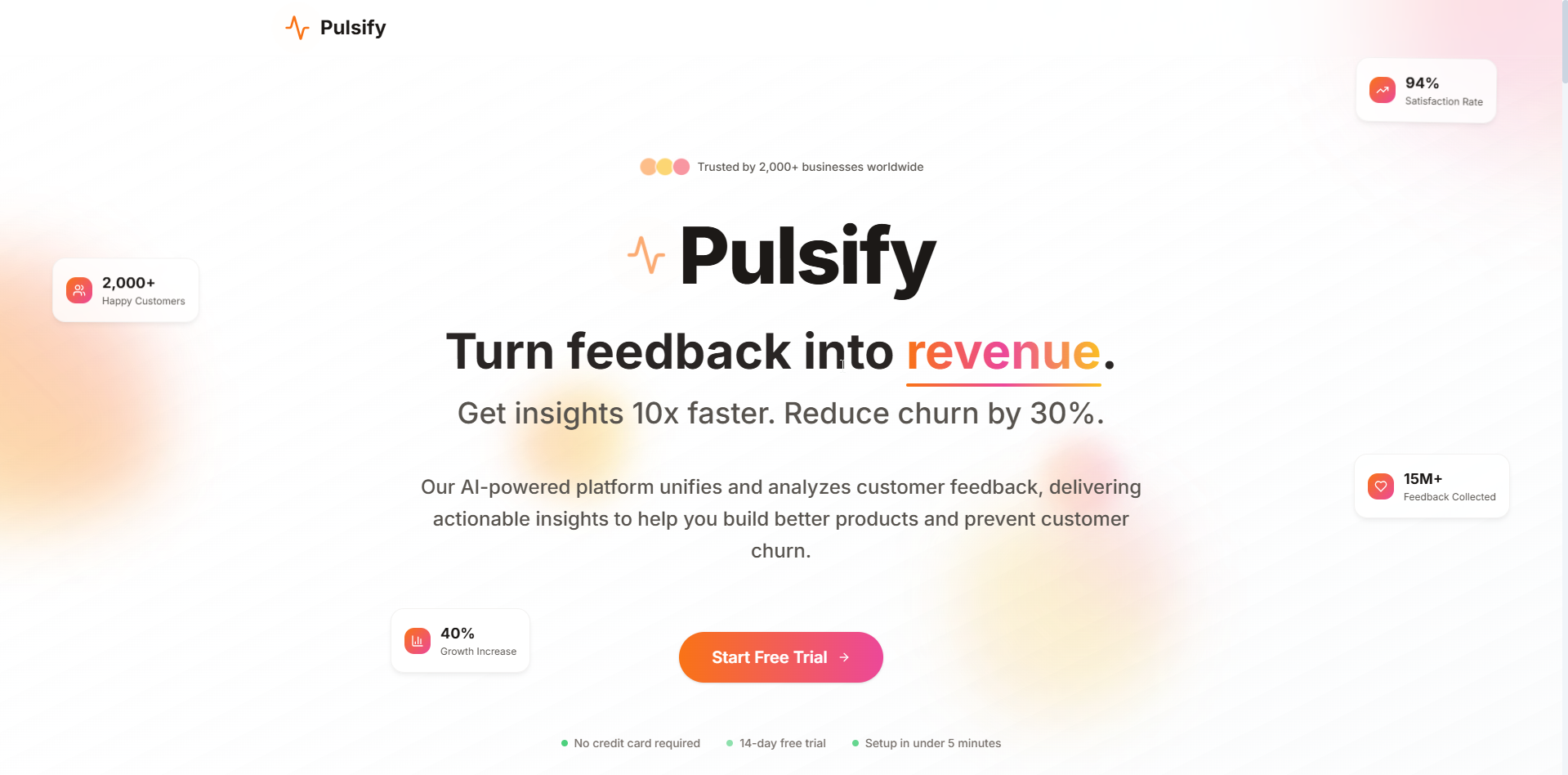
  • Pulsify

    Pulsify


    Pulsify — Early‑Stage Product Case Study

    Product Type: AI‑powered feedback management and business insights system
    Stage: Early launch / first users

    Project URL:
    https://pulsify.co.ke/ (pulsify.co.ke)


    The Problem

    Most businesses know customer feedback matters — but collecting it and transforming it into actionable insight is rarely easy.

    Common issues include:

    • Fragmented feedback: Comments and survey replies come from multiple sources with no single view
    • Analysis paralysis: Manual sorting, tagging, and insight generation is slow and error‑prone
    • Lack of clarity: Teams struggle to translate raw responses into strategic decisions

    These challenges slow down responsiveness, weaken customer loyalty, and ultimately cost companies revenue. For small and medium businesses especially, insight tools are either too generic or too complex.


    The Insight

    Listening to customers shouldn’t be a luxury.

    From early conversations with business owners and managers, three things became clear:

    • Feedback matters more than ever in competitive markets
    • Most teams don’t have dedicated analysts
    • AI can automate insight without sacrificing depth

    So the core insight became:

    Businesses need clear, fast, usable insights — not raw data streams.

    Pulsify was built around delivering actionable signal over noise, using AI to translate customer reactions into trends, priorities, and opportunities in real time. (pulsify.co.ke)


    The Solution

    Pulsify provides a centralized platform where businesses can collect, analyze, and act on customer feedback seamlessly.

    Unified Feedback Intake

    • Businesses can aggregate feedback from multiple channels into one dashboard
    • No manual data wrangling — everything is structured automatically

    AI‑Powered Insight

    • Natural language processing turns text responses into key themes
    • Prioritized trends highlight what truly matters to customers

    Actionable Recommendations

    • The system suggests next steps based on common sentiment and patterns
    • Reduces guesswork and speeds up improvement cycles

    Real‑Time Analytics

    • Insight dashboards update live as new feedback arrives
    • Visual charts help teams understand satisfaction, pain points, and growth drivers

    Early Signals & Validation

    Although Pulsify is early in its adoption curve, initial usage patterns suggest traction among first users:

    • Businesses report faster understanding of customer sentiment
    • Teams use insights to iterate offerings and improve customer experience
    • Feedback cycles that once took weeks are now handled in days

    These signs — faster decisions, clearer trends, and empowered teams — are exactly what the platform set out to enable. (pulsify.co.ke)


    Why This Matters

    Pulsify demonstrates a foundational product principle:

    Insights are only valuable when they are understood and acted on.

    Many feedback tools collect data but leave analysis to human teams — which often means results are delayed or ignored. Pulsify flips the model:

    • AI does the heavy lifting, so teams focus on impact
    • Real‑time analytics means insights happen while they still matter
    • Actionability becomes the priority, not just data capture

    This makes Pulsify especially valuable for:

    • Small & medium businesses without dedicated analysts
    • Customer experience teams looking to improve retention
    • Operations and product teams needing quick, clear feedback loops

    What’s Next

    As the platform evolves, key enhancements may include:

    • Richer integration with communication channels
    • Automated action workflows based on feedback triggers
    • Predictive customer satisfaction modeling
    • Benchmarking against industry trends

    The mission remains consistent: turn every customer voice into growth‑driving insight.


  • Lyrics App


    Tsinyimbu Tysa Nyasaye & Nyimbo Za Injili — Early‑Stage Music Lyrics Apps Case Study

    Product Type: Local music lyrics discovery & reference apps
    Stage: Early launch / first users

    Project URLs:


    The Problem

    Music lovers often want more than just audio: they want the words, meaning, and cultural context of the songs they love. But:

    • Song lyrics for local languages are scattered, inconsistent, or hard to find
    • Mainstream apps focus on global hits — local and traditional music often get overlooked
    • Fans and learners struggle to read and understand lyrics, especially in regional dialects like Luhyia and Swahili

    In short: fans want lyrics, but there’s no easy way to browse, search, or read them in native contexts. (Google Play)


    The Insight

    What if discovering song lyrics was as easy as tapping an app?

    Through early user interest and the music culture in Kenya, two clear truths emerged:

    • Music is deeply tied to language and identity
    • Fans care about lyrics as much as the songs themselves
    • People want a simple, searchable place for local and gospel music texts

    So instead of surfacing lyrics through fragmented web searches or unreliable sites, the apps deliver them in a purpose‑built, mobile‑friendly interface. (Google Play)


    The Solution

    Tsinyimbu Tysa Nyasaye focuses on lyrics in the Luhyia dialect — a rich regional language with significant cultural music content. (Google Play)
    Nyimbo Za Injili offers a curated set of Swahili gospel and worship lyrics, catering to churchgoers and spiritual music fans. (Google Play)

    Key design principles include:

    Local Language First

    • Lyrics presented in native dialects so fans see the words they actually want
    • Supports cultural connection and deeper appreciation of song meaning

    Simple Discovery Flow

    • Search by artist, song title, or lyric snippet
    • Easy browsing for both casual users and dedicated music lovers

    Lightweight & Accessible

    • Designed for Android devices with minimal barriers to install
    • Works even with modest connectivity

    Early Signals & Validation

    Both apps have seen early organic traction on Google Play:

    • 10K+ installs on each app, signaling real interest in local lyrics discovery (Google Play)
    • Positive signals (search volume, browsing patterns) indicate users are actively searching for lyrics content
    • Users appreciate the focus on specific language groups rather than generic lyric collections

    These are early behavioral signs — not vanity stats — that the core problem (lyrics scarcity) resonates with users in these communities.


    Why This Matters

    Linguistic diversity and cultural music are underrepresented in mainstream apps. These apps prove an important product principle:

    You don’t need to be global to be essential — you just need to solve a real problem for a real community.

    By focusing on:

    • Lyrics in native languages
    • Ease of search and readability
    • A clean, lightweight mobile experience

    these apps serve as cultural reference tools as much as music companions. (Google Play)

    Ideal early users:

    • Local language speakers and learners
    • Church members and worship teams (for gospel lyrics)
    • Music fans who want to understand lyrics deeply

    What’s Next

    Future roadmap priorities might include:

    • Audio playback links paired with lyrics
    • Offline lyric caching for low‑connectivity users
    • Crowdsourced lyric contributions and corrections
    • Language learning features tied to lyrics

    These features deepen utility while preserving simplicity.


    .