Category: SAAS

  • Pulsify

    Pulsify


    Pulsify — Early‑Stage Product Case Study

    Product Type: AI‑powered feedback management and business insights system
    Stage: Early launch / first users

    Project URL:
    https://pulsify.co.ke/ (pulsify.co.ke)


    The Problem

    Most businesses know customer feedback matters — but collecting it and transforming it into actionable insight is rarely easy.

    Common issues include:

    • Fragmented feedback: Comments and survey replies come from multiple sources with no single view
    • Analysis paralysis: Manual sorting, tagging, and insight generation is slow and error‑prone
    • Lack of clarity: Teams struggle to translate raw responses into strategic decisions

    These challenges slow down responsiveness, weaken customer loyalty, and ultimately cost companies revenue. For small and medium businesses especially, insight tools are either too generic or too complex.


    The Insight

    Listening to customers shouldn’t be a luxury.

    From early conversations with business owners and managers, three things became clear:

    • Feedback matters more than ever in competitive markets
    • Most teams don’t have dedicated analysts
    • AI can automate insight without sacrificing depth

    So the core insight became:

    Businesses need clear, fast, usable insights — not raw data streams.

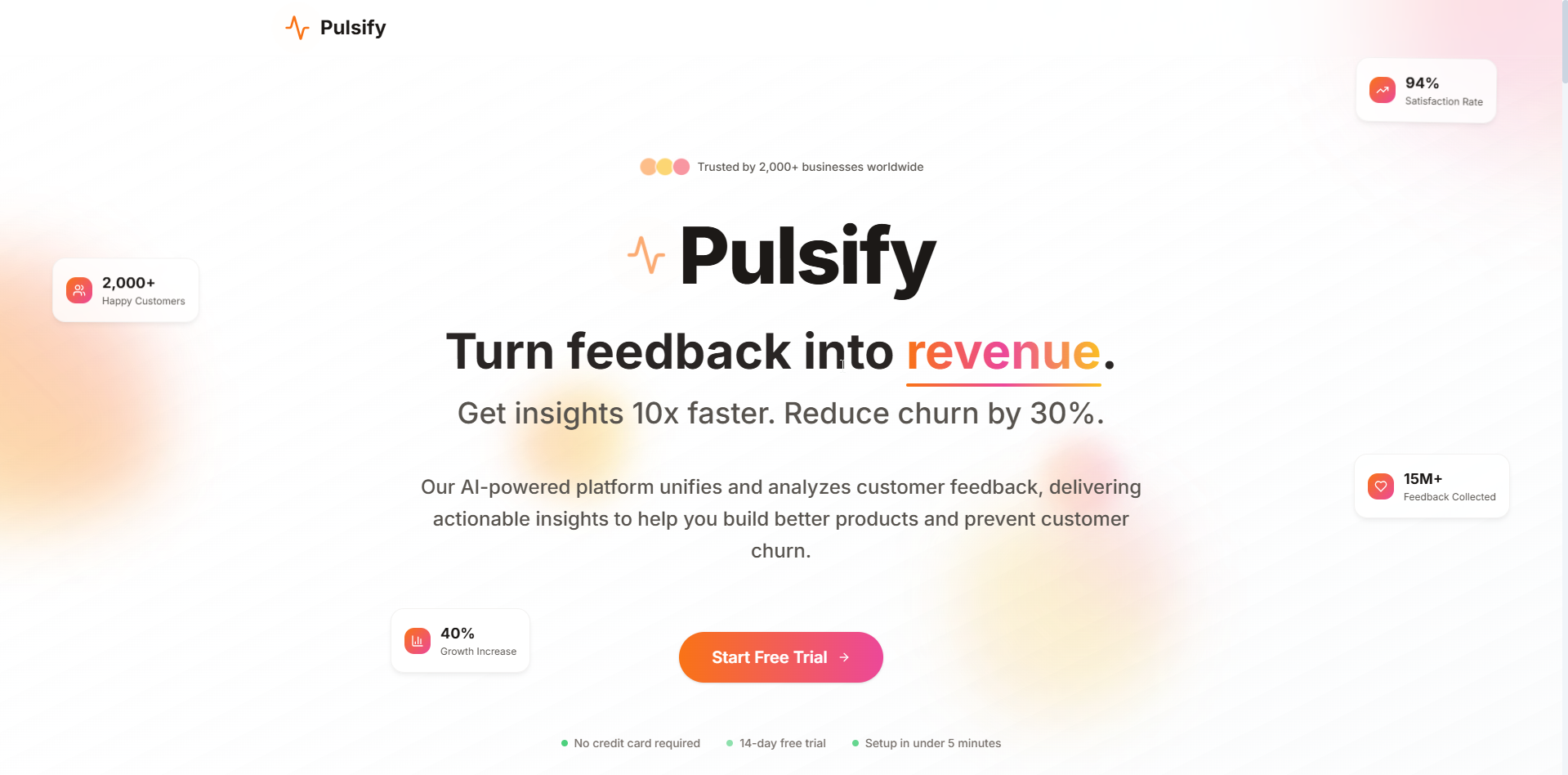
    Pulsify was built around delivering actionable signal over noise, using AI to translate customer reactions into trends, priorities, and opportunities in real time. (pulsify.co.ke)


    The Solution

    Pulsify provides a centralized platform where businesses can collect, analyze, and act on customer feedback seamlessly.

    Unified Feedback Intake

    • Businesses can aggregate feedback from multiple channels into one dashboard
    • No manual data wrangling — everything is structured automatically

    AI‑Powered Insight

    • Natural language processing turns text responses into key themes
    • Prioritized trends highlight what truly matters to customers

    Actionable Recommendations

    • The system suggests next steps based on common sentiment and patterns
    • Reduces guesswork and speeds up improvement cycles

    Real‑Time Analytics

    • Insight dashboards update live as new feedback arrives
    • Visual charts help teams understand satisfaction, pain points, and growth drivers

    Early Signals & Validation

    Although Pulsify is early in its adoption curve, initial usage patterns suggest traction among first users:

    • Businesses report faster understanding of customer sentiment
    • Teams use insights to iterate offerings and improve customer experience
    • Feedback cycles that once took weeks are now handled in days

    These signs — faster decisions, clearer trends, and empowered teams — are exactly what the platform set out to enable. (pulsify.co.ke)


    Why This Matters

    Pulsify demonstrates a foundational product principle:

    Insights are only valuable when they are understood and acted on.

    Many feedback tools collect data but leave analysis to human teams — which often means results are delayed or ignored. Pulsify flips the model:

    • AI does the heavy lifting, so teams focus on impact
    • Real‑time analytics means insights happen while they still matter
    • Actionability becomes the priority, not just data capture

    This makes Pulsify especially valuable for:

    • Small & medium businesses without dedicated analysts
    • Customer experience teams looking to improve retention
    • Operations and product teams needing quick, clear feedback loops

    What’s Next

    As the platform evolves, key enhancements may include:

    • Richer integration with communication channels
    • Automated action workflows based on feedback triggers
    • Predictive customer satisfaction modeling
    • Benchmarking against industry trends

    The mission remains consistent: turn every customer voice into growth‑driving insight.

  • Lipia Pole Pole

    Lipia Pole Pole


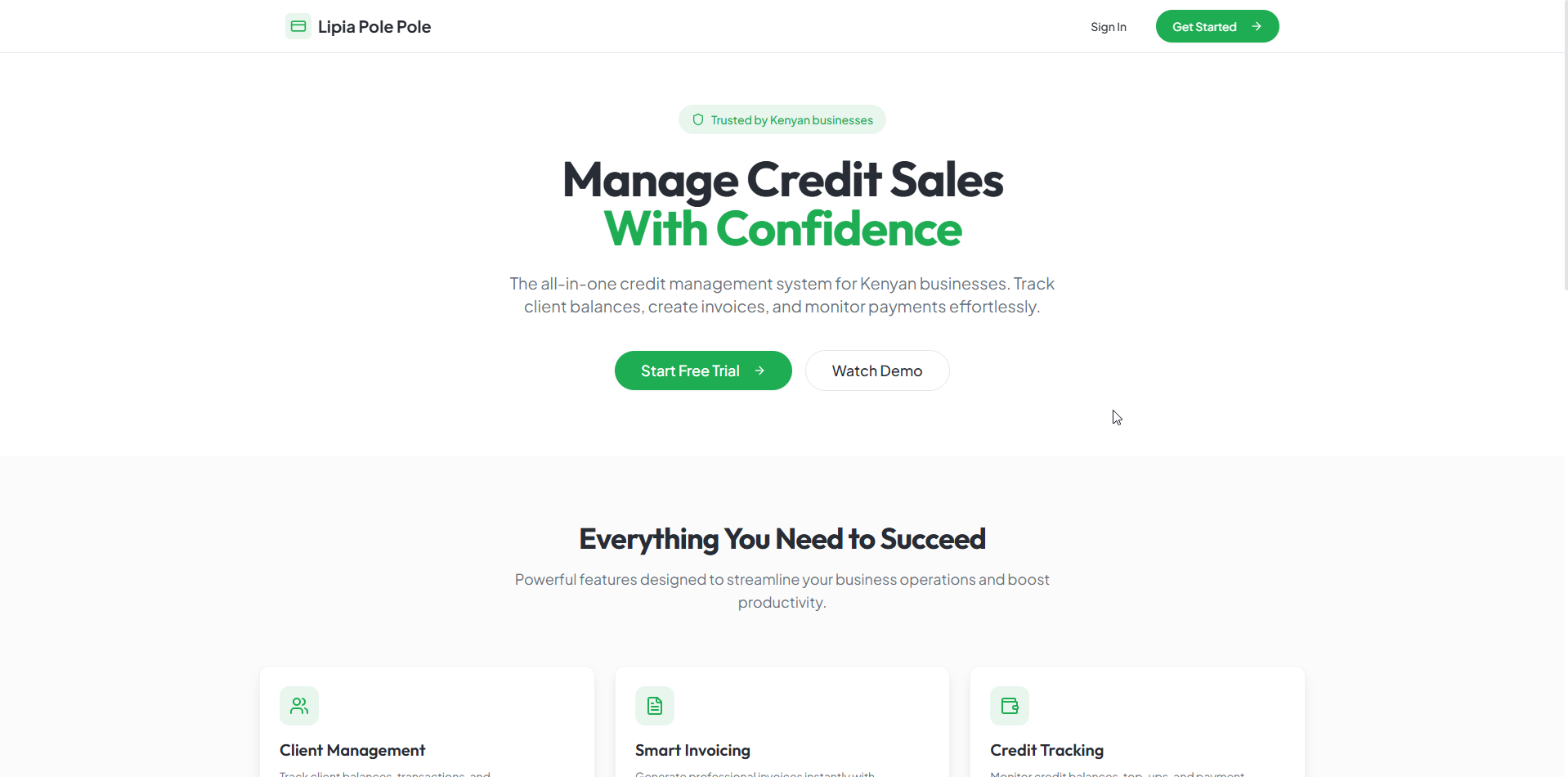
    Lipia Pole Pole — Early‑Stage Credit Management Platform Case Study

    Product Type: Credit management & invoicing system
    Stage: Early launch / first users

    Project URL:
    https://lipiapolepole.com/


    The Problem

    For many Kenyan businesses, credit management is a tangled mess of spreadsheets, WhatsApp messages, and memory. The typical pain points include:

    • No centralized client ledger — Balances and payment history live in scattered notes.
    • Invoice confusion — Creating, tracking, and reconciling invoices often creates more work than the sale itself.
    • Unreliable payment visibility — Businesses struggle to know who paid what and when.

    These inefficiencies cost time, burn valuable cash flow, and increase the risk of losses — especially for small service providers and MSMEs.


    The Insight

    Businesses don’t fail because they’re bad at credit — they fail because their systems are poorly suited to real workflows.

    From observing how local businesses handle credit and invoicing, a few truths emerged:

    • Owners want clarity, not complexity
    • Small teams don’t need enterprise ERP
    • They need real‑time, trustworthy data
    • They need something that just works

    Instead of adding yet another accounting layer, Lipia Pole Pole asks:

    What if you could manage credit with a system that feels familiar, not foreign?


    The Solution

    Lipia Pole Pole was created to give Kenyan businesses a simple, secure, and centralized way to manage credit, clients, and invoices — without the chaos.

    Client Management

    • Track every customer’s balance in one place
    • View payment history at a glance
    • Reduce disputes with clear records

    Invoice Tracking

    • Create and issue invoices instantly
    • Monitor statuses automatically — paid, pending, overdue
    • Eliminate manual follow‑ups and lost documents

    Secure & Reliable

    • Enterprise‑grade security for sensitive financial data
    • Encryption and access controls
    • Peace of mind for business owners and their clients

    All features are designed with Kenyan business realities in mind — low overhead, minimal setup, and immediate value.


    Early Signals & Validation

    Lipia Pole Pole, while early, already shows meaningful signals:

    • Users log clients and invoice data faster than in spreadsheets
    • Small businesses report fewer reconciliation headaches
    • Early users praise the visibility of payment history
    • Business owners feel more confident talking about cash-flow status to partners and lenders

    These are not vanity metrics — they’re early behavioral signals that the core problem is being solved.


    Why This Matters

    Lipia Pole Pole proves a simple but foundational product principle:

    Clarity drives confidence.

    When business owners know exactly who owes what, and when payments are due, they:

    • Plan smarter
    • Collect faster
    • Grow with assurance

    Most credit systems either bury data in complexity or leave gaps that create even more work. Lipia Pole Pole flips that:

    • Real‑time tracking beats post‑hoc reconciliation
    • Centralized client info beats scattered notes
    • Automated invoice statuses beat guesswork

    This makes it especially useful for:

    • MSMEs and freelancers
    • Small service providers
    • Shop owners and credit‑based businesses
    • Teams that prefer accuracy over chaos

    What’s Next

    As the product evolves, future enhancements include:

    • Reminders and automated payment nudges
    • Exportable financial reports
    • Integration with M‑Pesa and mobile money payouts
    • Multi‑user access and role permissions

    The core mission remains: Make credit simple and trustworthy so businesses can focus on growth, not spreadsheets.


  • ConstructLedger

    ConstructLedger


    ConstructLedger — Early‑Stage Product Case Study

    Product Type: Tactical profit tracking & project finance engine
    Stage: Early launch / first users

    Project URL:
    https://constructledger.bunisystems.com/


    The Problem

    Construction companies deserve to know exactly how profitable each project is — but real life rarely works that way.

    Common pain points include:

    • Unclear project profitability — Costs and revenues are scattered across spreadsheets, inboxes, and tribal knowledge
    • Delayed financial insight — Profit reporting often only happens after a job is done, too late for corrections
    • Data chaos — Materials, labor, equipment, subcontractor costs, and income are logged in disconnected systems

    The result? Decisions are based on gut instinct, not timely financial truth.


    The Insight

    The core business reality for construction is:

    Profit isn’t a high‑level summary — it’s a project‑by‑project story.

    Meaningful financial control doesn’t come from broad balance sheets — it comes from:

    • Knowing per job profit
    • Seeing costs as they happen
    • Tying expenses directly to deliverables

    Existing tools either over‑generalize (accounting suites) or require endless configuration (enterprise ERP), leaving small and mid‑size contractors in the lurch.

    But here’s the critical insight:

    Most construction teams don’t need complexity — they need clarity.


    The Solution

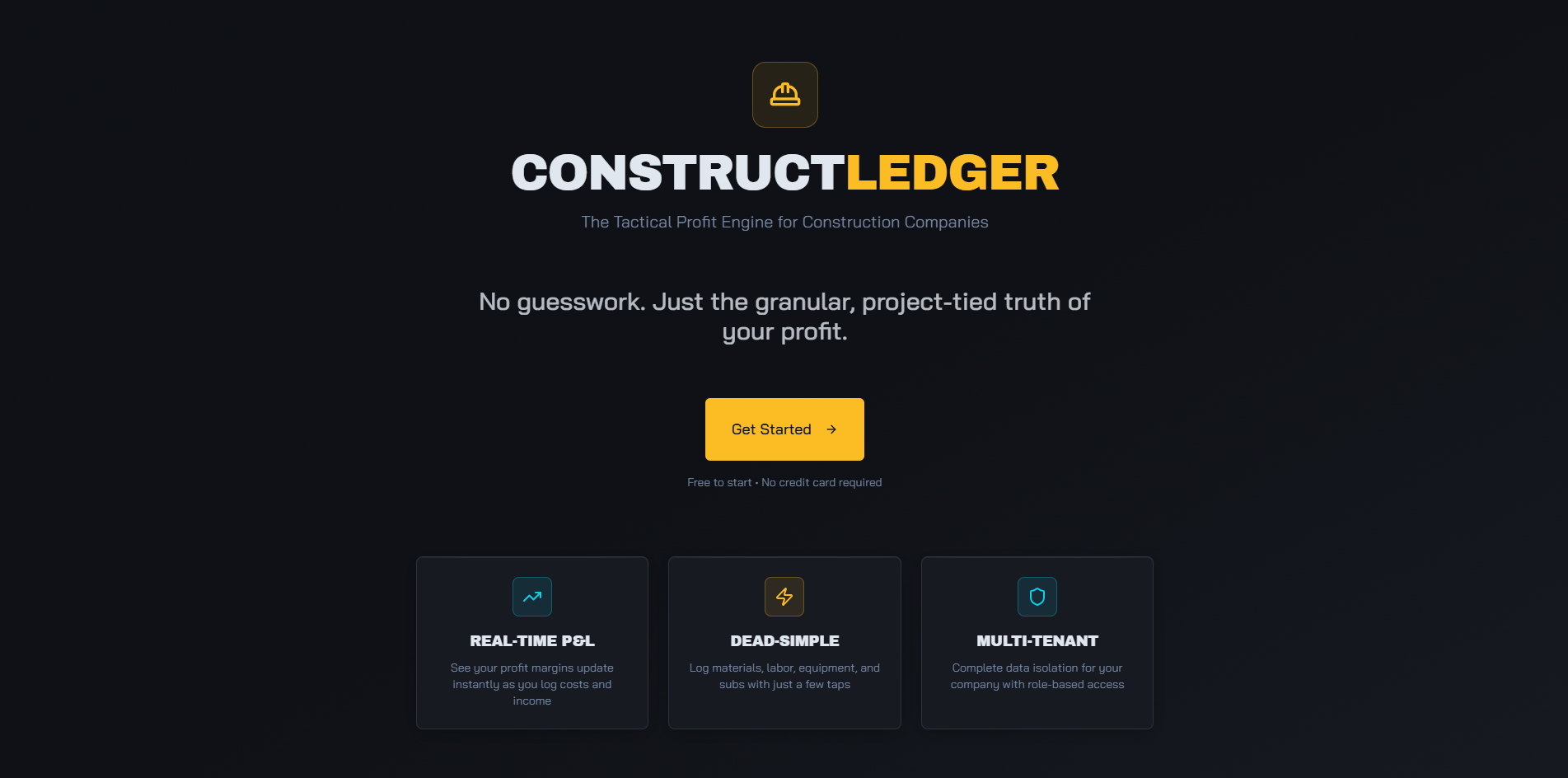
    ConstructLedger was designed to be simple, real‑time, and project‑centric, focusing on what matters most for construction profitability.

    Real‑Time P&L (Profit & Loss)

    See profit margins instantly as you log costs and income — no waiting for month‑end reports.

    Easy Cost Logging

    Log all major cost types with minimal friction:

    • Materials
    • Labor
    • Equipment
    • Subcontractors (subs)

    Just a few taps, no spreadsheet gymnastics.

    Multi‑Tenant with Role Access

    • Each company’s data is isolated
    • Role‑based permissions ensure the right team members see the right data
    • Scales from small teams to larger orgs

    Built for Construction Workflows

    Forget financial jargon and complex menus — ConstructLedger speaks project language:

    • Job by job reporting
    • Line‑item cost inputs
    • Profit visibility per task

    Early Signals & Validation

    ConstructLedger is early, but the initial traction is promising:

    • Users report faster visibility into profitability than traditional methods
    • Project managers appreciate real‑time updates vs. monthly reconciliations
    • Small construction teams use it as both an operational and financial tool
    • Early adopters describe it as “the profit clarity we always wished for

    No inflated vanity numbers — just honest, consistent signals that the tool is actually solving pain.


    Why This Matters

    ConstructLedger embodies a critical product principle:

    Profit clarity beats complexity every time.

    Traditional accounting systems are great for compliance — not for day‑to‑day project decision making in construction.

    By focusing on:

    • Real‑time P&L
    • Minimal logging friction
    • Project‑centered workflows

    ConstructLedger enables teams to feel the financial truth while the job is still live, not after the fact.

    This makes it especially powerful for:

    • Small & mid‑size contractors
    • Project managers responsible for margins
    • Teams that prefer answers over guesswork

    What’s Next

    As ConstructLedger matures, the roadmap prioritizes:

    • Invoicing and payment reconciliation
    • Cost forecasting & variance analysis
    • Mobile‑optimized data capture
    • Reporting exports & integrations with existing finance tools

    The mission remains the same: make profit visible, actionable, and immediate.


  • GratitudeFlow

    GratitudeFlow


    GratitudeFlow — Early-Stage Product Case Study

    Product Type: AI-assisted gratitude & reflection platform
    Stage: Early launch / first users

    Project URL:
    https://gratitudeflow.bunisystems.com/


    The Problem

    Most people like the idea of gratitude journaling.
    Very few stick with it.

    Through observation and hands-on use of existing journaling apps, three consistent problems emerged:

    • High friction — Too many steps, long prompts, or blank-page paralysis
    • Low emotional payoff — Entries start to feel repetitive or shallow
    • No feedback loop — Users write, but gain no insight or sense of progress

    The result is predictable:
    People start motivated, then quietly abandon the habit within days.


    The Insight

    Gratitude doesn’t fail because people lack discipline.
    It fails because most tools ignore how people actually behave.

    What works in practice:

    • Short reflections, not essays
    • Gentle guidance, not rigid structure
    • Emotional feedback, not passive storage

    Core insight:
    Gratitude becomes a habit when reflection feels effortless and emotionally rewarding.

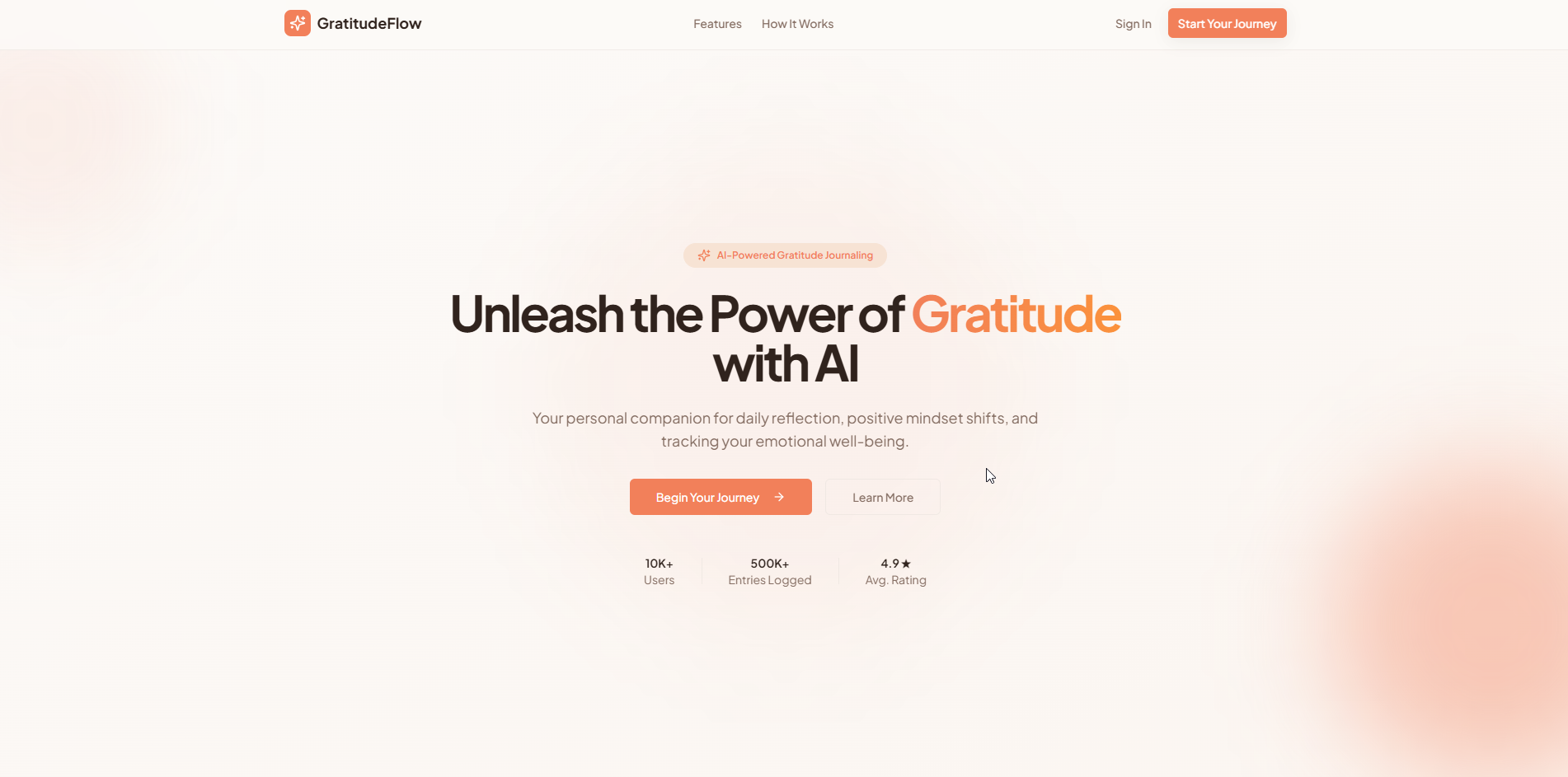
    Instead of building “another journal,” GratitudeFlow was designed as a reflection flow—something users can complete in under two minutes and still feel meaningfully different afterward.


    The Solution

    GratitudeFlow was built with behavior first, features second.

    Frictionless Daily Reflection

    • Minimal input required to begin
    • No intimidating blank pages
    • Focus on small, real moments rather than forced positivity

    Guided, Adaptive Prompts

    • Prompts help users articulate thoughts they already have
    • Removes decision fatigue (“What should I write today?”)

    Emotional Awareness Over Productivity

    • No aggressive gamification
    • Emphasis on awareness, calm, and continuity

    Mobile-First, Calm UX

    • Clean interface that stays out of the way
    • Designed for quiet moments, night use, and low mental energy

    Early Signals & Validation

    GratitudeFlow is still early, but several qualitative signals stand out:

    • Users complete reflections quickly, lowering resistance to daily use
    • First-time users describe the app as lighter than traditional journals
    • Reflection completion rates are strong for first-time sessions
    • Users describe the experience as calming rather than effortful

    No vanity metrics—just early confirmation that the behavioral assumptions are holding.


    Why This Matters

    GratitudeFlow demonstrates a broader product principle:

    Tools that support emotional habits must reduce effort before increasing insight.

    Instead of asking users to do more, GratitudeFlow:

    • Asks less
    • Guides gently
    • Reflects meaning back to the user

    This makes it especially suited for:

    • First-time journalers
    • Emotionally tired users
    • People who want reflection without overthinking

  • Syndra M-Pesa Wrapper

    Syndra M-Pesa Wrapper

    M-Pesa Wrapper — Early-Stage Developer Payments Platform Case Study

    Product Type: Developer-focused M-Pesa API wrapper
    Stage: Early launch / first users

    Project URL:
    https://syndra.bunisystems.com/


    The Problem

    Integrating M-Pesa payments into apps is notoriously painful.

    • Confusing documentation — Safaricom’s API docs are dense and hard to follow.
    • Callback headaches — Developers waste hours troubleshooting STK Push, C2B, and B2C responses.
    • Security and multi-tenancy gaps — Scaling across multiple users or clients is complex and error-prone.

    The result? Developers spend more time wrestling with payments than building actual features.


    The Insight

    Developers don’t need another payment service—they need clarity, reliability, and control.

    From observing fintech developers and early adopters:

    • Debugging M-Pesa integrations is a recurring frustration
    • Developers abandon integrations if callbacks fail or security is brittle
    • Simplified tooling dramatically reduces time-to-production

    Key insight:

    Make payments “just work” without compromising flexibility, multi-tenancy, or security — and developers will actually use it.


    The Solution

    M-Pesa Wrapper was designed developer-first to remove pain points and make payment integration predictable and fast.

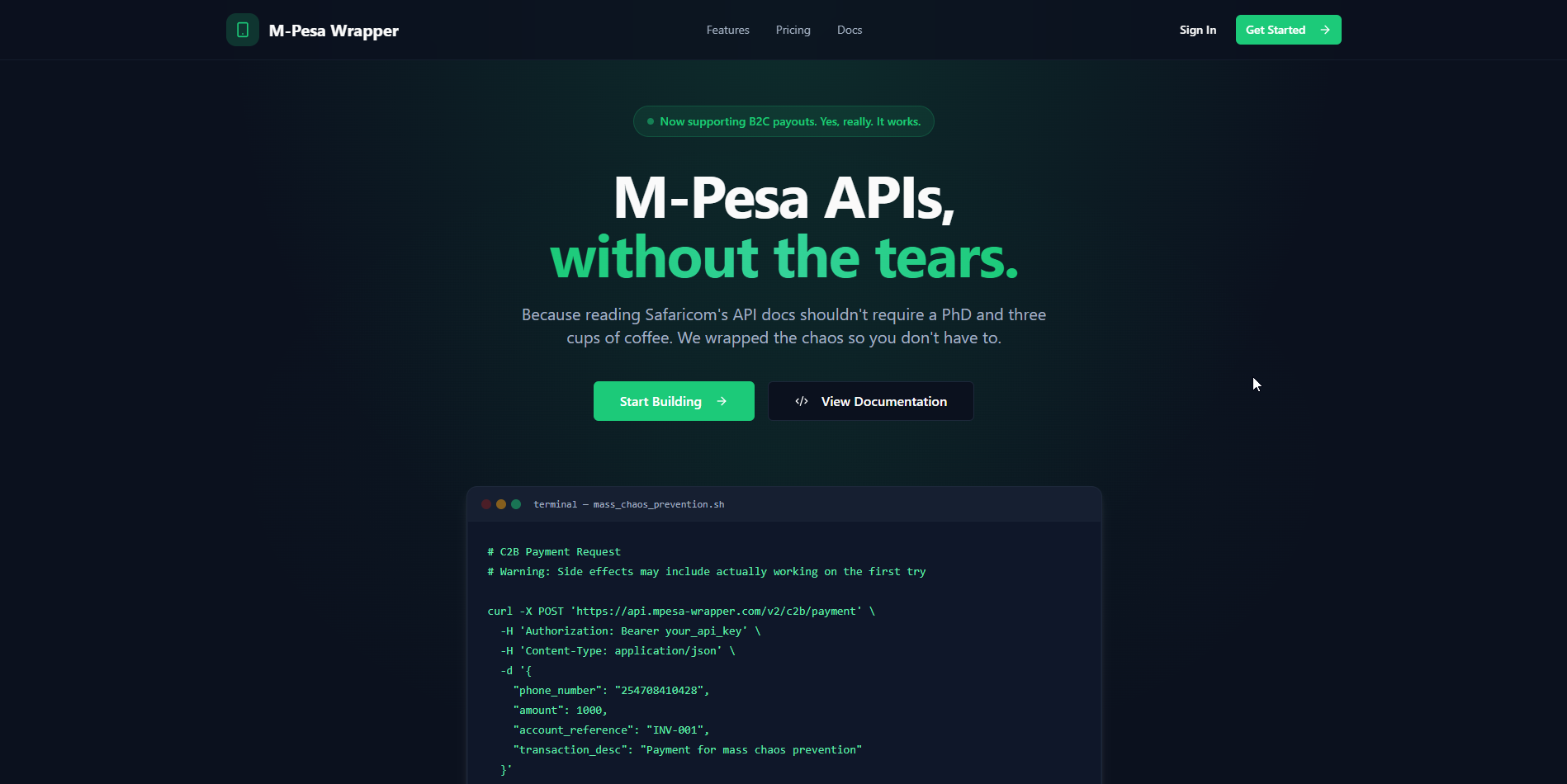
    Developer-Focused API

    • Clean REST APIs with proper documentation
    • Ready-to-use examples and STK Push / C2B / B2C endpoints
    • Callback handling is automatic — developers never chase missing responses

    Multi-Tenant Architecture

    • Isolates customers in dedicated tenants
    • Enables scalable, secure deployments for multiple clients

    Scoped API Keys & Enterprise Security

    • Generate keys with granular permissions
    • JWT auth, role-based access control, encryption everywhere

    Real-Time Payments & Analytics

    • Instant STK Push, B2C, C2B
    • Built-in dashboards visualize transactions
    • Early users can track and prove ROI quickly

    Developer-Friendly Experience

    • Free tier for testing & hobbyists
    • Paid tiers scale gracefully for small businesses, serious builders, and enterprise
    • Humorous, humanized tone reduces friction and builds trust

    Early Signals & Validation

    Initial adoption signals confirm the assumptions:

    • Developers integrate in minutes rather than hours
    • Test transactions and callbacks succeed consistently on first try
    • Users report reduced support tickets and faster go-to-market cycles
    • Analytics dashboards improve transparency and stakeholder confidence

    Even at early stage, M-Pesa Wrapper validates: simpler, reliable developer tooling accelerates fintech product launches.


    Why This Matters

    M-Pesa Wrapper proves a principle for fintech and developer platforms:

    Eliminate integration pain first; users will adopt before features matter.

    Key differentiators:

    • Reliability over complexity
    • Developer-first thinking, not enterprise-first documentation
    • Humor and clarity build trust in a painful ecosystem

    Ideal for:

    • Early-stage fintech startups
    • Independent developers building payment-enabled apps
    • Companies scaling multiple client integrations

    What’s Next

    Future priorities:

    • Expand multi-tenancy and enterprise features
    • Introduce more API endpoints and webhook support
    • Enhance analytics and real-time dashboards
    • Maintain frictionless onboarding while growing the user base

    The focus remains: developers spend time building features, not debugging payments.